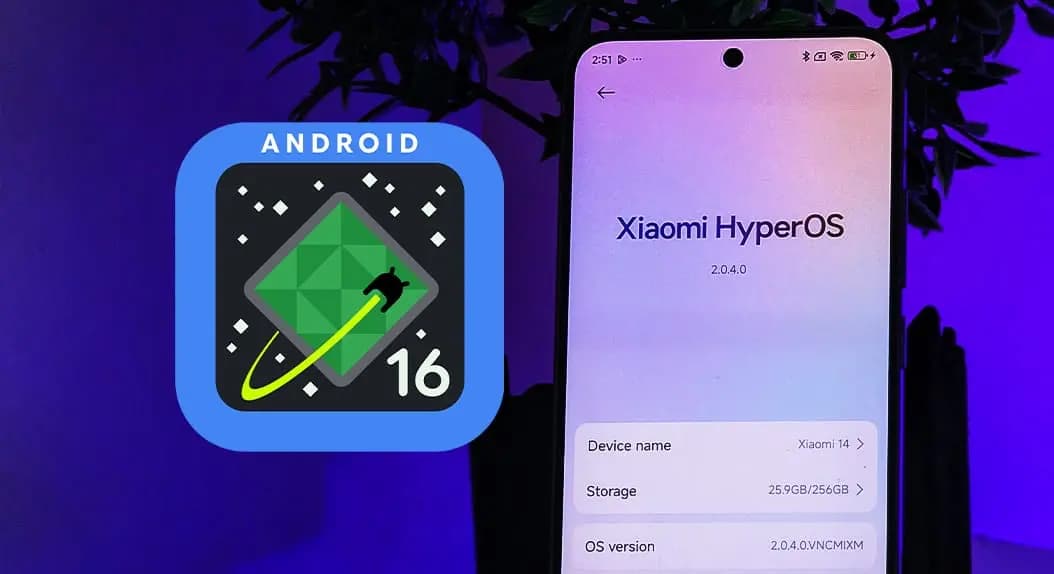
Official Android 16 support list from Xiaomi

Many computer fans are surprised by Google’s recent statement that it will release two Android SDK updates per year. Thus, Android 16 can be released much in advance of this cycle, before June 2025. All devices are currently receiving Android 15 upgrades, but Xioami is preparing for the next major step—integrating Android 16 capabilities into their next HyperOS.
The complete list of Xiaomi, Redmi, and POCO devices that could receive the update to HyperOS, an Android 16-based operating system, is provided below. It is easily grouped for your review.

Current Android 16 released Devices
Android 16 is currently released based on HyperOS 2.3.
- Xiaomi 15
- Xiaomi 14T Pro
- REDMI K70 Ultra
Xiaomi Flagship Devices
Currently, high-end models with great performance and features are taking center stage in Xiaomi’s update plans:
- Xiaomi 13 (fuxi)
- Xiaomi 13 Lite (ziyi)
- Xiaomi 13 Pro (nuwa)
- Xiaomi 13 Ultra (ishtar)
- Xiaomi 13T (aristotle)
- Xiaomi 13T Pro (corot)
- Xiaomi 14 (houji)
- Xiaomi 14 CIVI (chenfeng)
- Xiaomi 14 Pro (shennong)
- Xiaomi 14 Ultra (aurora)
- Xiaomi 14T (degas)
- Xiaomi 14T Pro (rothko)
- Xiaomi 15 (dada)
- Xiaomi 15 Pro (haotian)
- Xiaomi 15 Ultra (xuanyuan)
- Xiaomi 15S Pro (dijun)
- Xiaomi CIVI 5 Pro (luming)
- Xiaomi Civi 2 (ziyi)
- Xiaomi Civi 4 Pro (chenfeng)
- Xiaomi MIX FLIP (ruyi)
- Xiaomi MIX FLIP 2 (bixi)
- Xiaomi MIX FOLD 4 (goku)
- Xiaomi Mix Fold 3 (babylon)
- Xiaomi Pad 6 Max 14 (yudi)
- Xiaomi Pad 6 Pro (liuqin)
- Xiaomi Pad 6S Pro 12.4 (sheng)
- Xiaomi Pad 7 (uke)
- Xiaomi Pad 7 Pro (muyu)
- Xiaomi Pad 7 Ultra (jinghu)
- Xiaomi Pad 7S Pro 12.5 (violin)
Redmi Devices
Known for good-level performance at competitive prices
- REDMI K Pad (turner)
- REDMI K80 (zorn)
- REDMI K80 Pro (miro)
- REDMI K80 Ultra (dali)
- REDMI Pad 2 (taiko)
- REDMI Pad 2 4G (koto)
- REDMI Turbo 4 (rodin)
- REDMI Turbo 4 Pro (onyx)
- Redmi 13 (moon)
- Redmi 13 5G (breeze)
- Redmi 13X (moon)
- Redmi 14C (lake)
- Redmi A3 Pro (lake)
- Redmi A4 (warm)
- Redmi K60 Pro (socrates)
- Redmi K60 Ultra (corot)
- Redmi K70 (vermeer)
- Redmi K70 Pro (manet)
- Redmi K70 Ultra (rothko)
- Redmi K70E (duchamp)
- Redmi Note 13 Pro (garnet)
- Redmi Note 13 Pro+ (zircon)
- Redmi Note 13R (breeze)
- Redmi Note 14 (beryl)
- Redmi Note 14 4G (tanzanite)
- Redmi Note 14 Pro (malachite)
- Redmi Note 14 Pro 4G (obsidian)
- Redmi Note 14 Pro+ (amethyst)
- Redmi Note 14S (emerald_r)
- Redmi Pad Pro (dizi)
- Redmi Pad Pro 5G (ruan)
- Redmi Pad SE 8.7 Wi-Fi (flare)
- Redmi Turbo 3 (peridot)
- Xiaomi Redmi Pad (yunluo)
POCO Devices
- POCO C75 (lake)
- POCO C75 5G (warm)
- POCO F6 (peridot)
- POCO F6 Pro (vermeer)
- POCO F7 (onyx)
- POCO F7 Pro (zorn)
- POCO F7 Ultra (miro)
- POCO M6 (moon)
- POCO M6 Plus 5G (breeze)
- POCO M7 Pro 5G (beryl)
- POCO Pad (dizi)
- POCO X6 5G (garnet)
- POCO X6 Pro (duchamp)
- POCO X7 (malachite)
- POCO X7 Pro (rodin)
What to expect from Android 16:
With HyperOS’s integration of Android 16, we can expect:
- Enhanced multitasking by improving window management and application performance. Advanced AI features like improved accessibility, translation, and on-device processing.
- Polished UI/UX with smoother animations and further personalization.
- Better privacy and security settings to complement those updates made by Google.
Xiaomi makes sure that its devices remain competitive and feature-rich with regular Android updates as it keeps innovating. When Android 16 is released before the middle of 2024, the Xiaomi, Redmi, and POCO devices on the list will have access to the most advanced features of the most recent Android SDK. Once Xiaomi begins to push out the HyperOS improvements to these devices, more information will be released.
Samsung Galaxy Watch 8

Google Pixel Watch 4

Google Pixel 9
Comments & Discussions
Join the conversation! We use Disqus to handle comments. Click the button below to load the comment section.
Keep Reading
When it comes to sheer feature breadth, Android generally has the upper hand. Split-screen multitasking, desktop PC mode via an external monitor, the ability to swap out the default launcher — these are things iPhones simply can’t do. Customization and openness have always been Android’s calling card. Even so, Apple has quietly built a set […]

Honor is deep in development on MagicOS 11, and fresh details suggest the company is going all-in on a visual overhaul — one that will bring a Liquid Glass-inspired interface to its devices. Following iOS 26 and HarmonyOS 7, Honor appears ready to join the glass UI wave with its own take on the aesthetic. […]

A few hours before Huawei officially unveiled HarmonyOS 7.0 at HDC 2026, the company quietly dropped OpenHarmony 7.0 Beta 1 — a pre-release build that had first surfaced three weeks earlier and has now been formally released as a public testing framework for device makers and developers. OpenHarmony serves as the open-source foundation that device […]

Samsung has extended the June 2026 Android security update beyond the Galaxy S26 lineup, with the patch now rolling out to the Galaxy S25 series, Galaxy S25 Edge, and Galaxy Z Fold 7. The update weighs in at around 900MB and delivers 45 security fixes in total, with the rollout beginning in South Korea before […]

Huawei took the wraps off HarmonyOS 7 at its Huawei Developer Conference (HDC) on June 12, 2026. The new OS update spans smartphones, tablets, PCs, wearables, and IoT devices, with Yu Chengdong – Huawei’s Executive Director, Chairman of the Product Investment Review Committee, and Chairman of the Consumer Business Group – officially announcing the update […]

Screen Reactions, teased at the Android Show just a few weeks ago, are now live in Android 17 QPR1 Beta 4 for eligible Pixel phones. With this latest Android 17 preview build, there’s now a clearer picture of how the green screen-like effect actually works. It’s built directly into the system screen recorder — no […]