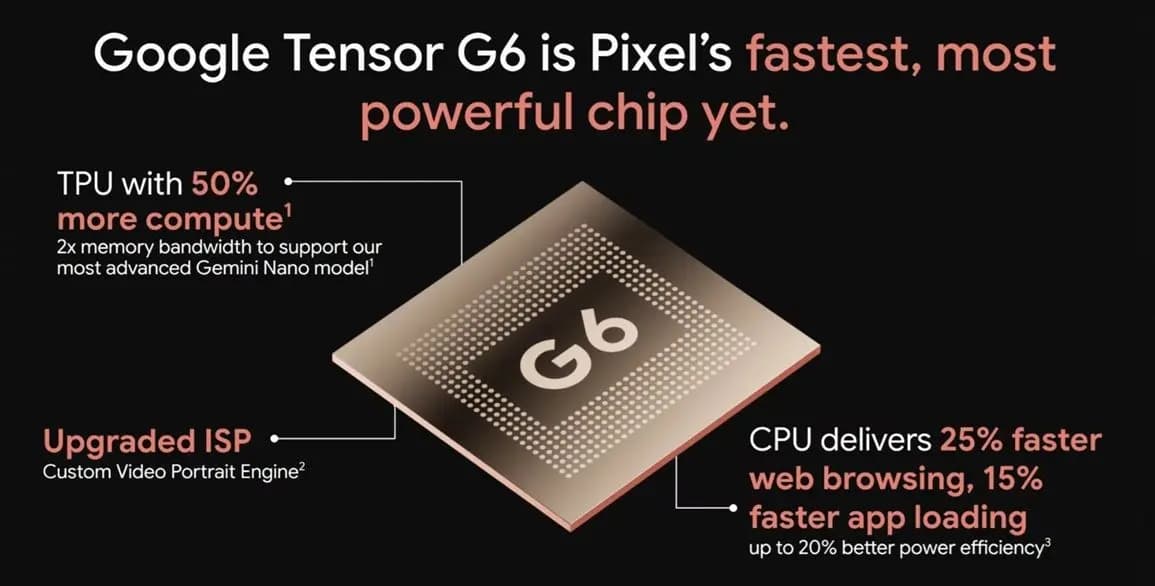

Google Tensor G6 is the custom processor powering the Pixel 11 series and Pixel 11 Pro Fold, with Google prioritizing energy efficiency and on-device AI over benchmark-leading specifications. The chip brings an upgraded CPU, a faster TPU, a new ISP, and a custom modem, enabling features that include 4K Portrait Video, Instant Night Sight, and up to 120x Pro Zoom.
That continues Google’s established approach to Tensor. Instead of competing through raw specification-sheet numbers, the company presents its processor through the Pixel experiences it enables, particularly features that keep AI processing on the device across the new lineup.
Google has not provided every technical detail about its new processor. However, company claims and information gathered during Android Authority’s brief Pixel 11 hands-on offer a clearer picture of the performance, AI, camera, and security changes.
Google claims the Tensor G6 CPU delivers up to 20% better power efficiency than the Tensor G5. Based on tests performed with pre-production hardware, the company also reports up to 25% faster web browsing and app loading times improved by as much as 15% during everyday use. These results remain Google’s figures until independent testing can verify them.
The company says it has optimized Tensor G6 for demanding mobile games, specifically naming Asphalt Legends, Disney Speedstorm, and Squad Busters. That focus stands out because gaming has not traditionally been Tensor’s strongest area. A new custom modem accompanies the processor and is designed to provide higher throughput while drawing less power, although Google has not identified its vendor.
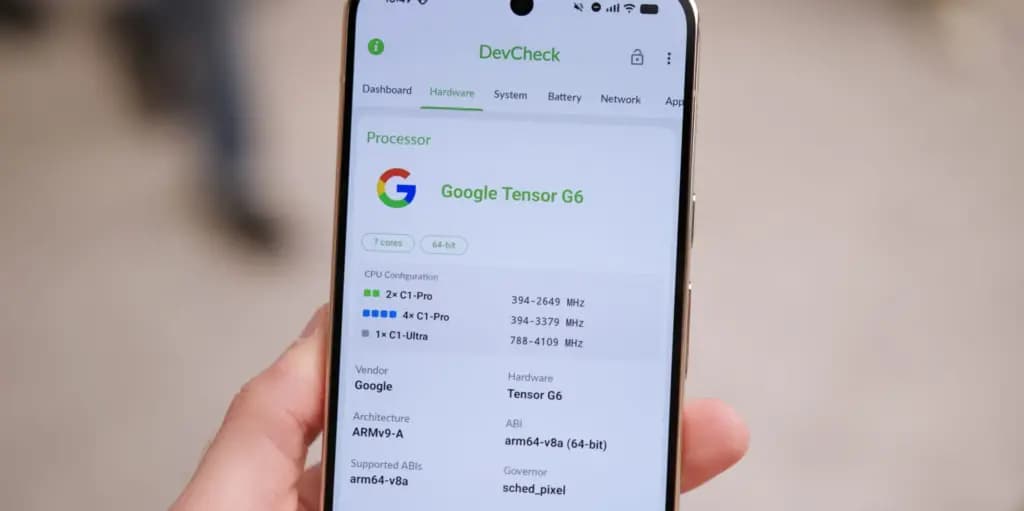
During its brief hands-on, Android Authority found a seven-core CPU layout. It consists of one prime “C1 Ultra” core running at 4.1GHz, four performance “C1 Pro” cores at 3.4GHz, and two efficiency “C1 Pro” cores at 2.65GHz. The GPU appears to be a six-compute-unit PowerVR C-series design clocked at 1.3GHz.
By comparison, Tensor G5 used one ARM Cortex-X4 core at 3.78GHz, five ARM Cortex-A725 cores at 3.05GHz, and two ARM Cortex-A520 cores at 2.25GHz. Its graphics component was a PowerVR DXT-48-1536.
The upgraded Tensor Processing Unit is central to Google’s Tensor G6 strategy. Google developed the chip’s silicon architecture alongside Google DeepMind’s latest AI models, giving the TPU 50% more compute power and higher memory bandwidth.
Those changes allow the on-device Gemini Nano model to operate with lower latency and higher quality, according to Google. For background jobs such as notification summaries and voice transcripts, Tensor G6 can reportedly run local workloads up to 3.5x faster while consuming up to 3.5x less energy.
The increased local processing capacity also makes it possible to handle certain demanding AI functions without sending the work elsewhere. One example cited in the source is Gboard’s new sign-to-text translation feature, which runs entirely on the device.
Tensor G6 includes an upgraded Imaging Signal Processor with a dedicated hardware accelerator for video portraits. This enables 4K Portrait Video on a Pixel for the first time.
Instant Night Sight is another major addition. Google says the feature allows the new phones to capture low-light photos up to 4.5x faster than earlier Pixel generations without reducing image quality. The more powerful TPU and ISP are also claimed to improve detail over extreme distances.
On the Pixel 11 Pro models, excluding the Fold, that processing supports up to 120x Pro Zoom. The standard Pixel 11 and Pixel 11 Pro Fold instead offer 30x Super Zoom.
Although the Pixel 11 Pro Fold contains the upgraded Tensor G6 ISP, Google confirmed that its physical layout and sensor constraints prevent it from supporting 4K Portrait Video and Instant Night Sight. The foldable retains 30x Super Zoom and hardware-accelerated AV1 encoding. AV1 acceleration is also available across the remaining Pro lineup.
Security receives its first major hardware refresh in roughly five years through the new Titan M3 security chip. Working with Tensor G6, Titan M3 enables a quantum-safe boot process built around post-quantum cryptography.
Google intends the system to protect user data from emerging and highly advanced digital threats. According to the source, this makes the Pixel 11 series one of the first consumer smartphone lineups to offer this type of forward-looking defense.
Despite outlining the experiences enabled by Tensor G6, Google remains guarded about many of its detailed specifications. Claims concerning efficiency, speed, gaming, AI performance, and camera quality will therefore need deeper testing once the Pixel 11 series is available for extended evaluation.
Ring Indoor Cam 2K

Luiza Mosneagu is Reviews Editor at Droid Tools. A psychologist by training and tech writer by passion, she has tested over 60 Android devices since 2020 - always for a minimum of two weeks before writing a word. Her focus is camera quality, everyday usability, and cutting through marketing claims to tell you what a device is actually like to live with.

Google has extended free Pixel 9 Satellite SOS access for an extra year, while long-term plans and potential subscription fees remain unannounced.

Qualcomm denies Snapdragon 8 Elite Gen 6 overheating claims in Samsung Galaxy S27 Ultra testing, though questions about the Extreme model remain unresolved.

Google's Noto 3D emoji are appearing on additional Android phones after launching on Pixel 11, likely arriving through a system update.

Hirudo Android malware replaces legitimate banking apps with modified copies to bypass checks and steal credentials, according to ThreatFabric.
The next story loads as you reach the end. You can also load it using the button.


Comments & Discussions
Join the conversation! We use Disqus to handle comments. Click the button below to load the comment section.